Meanwhile, Ross' Landing has cost $13,700 every day.
And many citizens still don't understand River City Company's authority
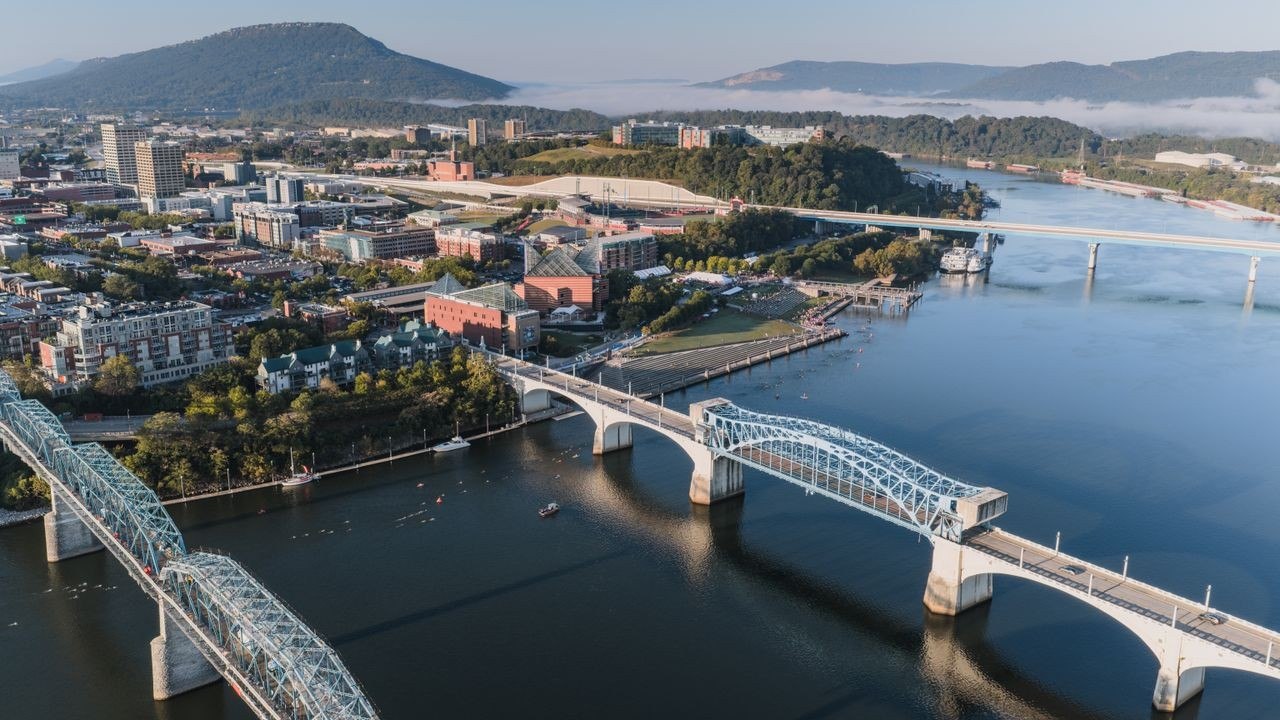
REBUILDING THE FRONT PORCH, AGAIN
This November, Chattanooga's front porch closes again. Ross' Landing, Chattanooga Green and the Riverfront between the Market Street and Olgiati bridges will be fenced off for about 18 months, reopening in 2028 after a roughly $50 million renovation called Riverfront Parks NEXT.
It will be the third major round of spending on the same ground in about 20 years. First came the $120 million 21st Century Waterfront, finished in 2005. Then came millions in repairs when parts of it cracked, leaked and sank. Now comes a new vision, because the last one, by its own sponsor's account, is underutilized.
I'm going to the public record to raise two questions: Has Ross' Landing become a costly, perpetual boondoggle? And does any ordinary Chattanoogan understand the power of River City Company, the public-private nonprofit partnership which seems to have outsized control over public land?
NOT GOVERNMENT, NOT QUITE PRIVATE
River City Company describes itself as a private nonprofit and the economic development engine for downtown. It was founded in 1986, largely through the Lyndhurst Foundation, and started with $12 million from about 15 local foundations and banks. It made key investments when land was cheap, cementing its participation in downtown through putting early stakes in a lot of ground.
On its Form 990, River City is classified as a supporting organization under section 509(a)(3) of the tax code. The two organizations it exists to support are named outright: the City of Chattanooga and Hamilton County. Its stated mission, repeated on every recent return, is to assist and support the city and county governments.
So for tax purposes, River City exists to serve our local governments and ostensibly city and county citizens. For public records and open meetings purposes, it is treated as a private organization. That gap creates a lot of confusion, even for other organizations who have used land in River City's purview for decades.
THE SAME PEOPLE IN TWO ROOMS
River City's 990 says plainly that the city and county are directly engaged in its governance, as both mayors sit on its board. The chair of the City Council and the chair of the County Commission each serve or submit a designee.
In the fiscal year that ran from July 2024 to June 2025, the year the City Council adopted the riverfront framework plan, the board of 20 included Mayor Tim Kelly, Mayor Weston Wamp, Councilwoman Jenny Hill and Commissioner Jeff Eversole. The board's vice chair, Roy Vaughn, was announced in 2022 as a BlueCross BlueShield of Tennessee representative. BlueCross later committed $10 million to the Ross' Landing project.
None of that is improper and I'm making no such allegation. Mayors on a downtown development board make a certain kind of sense. But it means the same officials who answer to voters in public chambers also deliberate in a private boardroom, and only one of those rooms is covered by Tennessee's open meetings law. My belief is River City's structure is so infused in public land that its meetings are just as important for citizen consideration as the council chambers covered by sunshine laws. To many, River City sits behind a very large green curtain. Its president and CEO was paid $246,334 in fiscal 2025, according to its 990, more than Governor Lee's $224,000 salary.
VOTES ON THE VISION, NOT THE CLOSURE
To be fair, the City Council and County Commission have voted on this project, on the record. In August 2024 the council passed Resolution 32207, adopting the 2024 Evolving Our Riverfront Parks Framework Plan. Later resolutions hired River City as the consultant, with $500,000 from the city and $700,000 from the county, followed by further interlocal agreements for construction documents.
But look at what those votes actually covered, and you'll see why so many are frustrated by River City. Adopt a vision. Hire River City. Fund the design work. None of them included the necessity to close Ross' Landing for 18 months. When the 2024 plan was unveiled, the published timeline even called for phase one to start in November 2025 and finish in 2026. The full 18-month shutdown took shape later, in River City's planning process, and reached the council as a foregone conclusion. When River City emerges from behind the green curtain with its presentations, it becomes hard to unwind the particulars.
That is the maddening pattern. The public votes authorize River City to work out the details in River City's conference room. By the time they come back to chambers, state grants are committed, contracts are signed and private donors have pledged. At that point a council briefing is merely a rubber stamp notification, not a representative process where deliberation can change much.
WHOSE LAND IS IT?
Ross' Landing is a city park, not River City's property. But River City has stewarded the riverfront corridor for nearly 40 years, and it owns a good deal of downtown in its own right.
Much of that came from its founding money. River City used part of its original $12 million to buy 34 acres connecting downtown to the river. It owns Miller Plaza and other properties whose rents, about $1.3 million a year in net rental income, pay for most of its operations. Its latest 990 lists land, buildings and improvements worth about $16.5 million on its books, plus two newly formed real estate holding companies.
Then there is Hawk Hill. When the Lookouts left AT&T Field, owner Frank Burke donated the stadium to River City, and the land moved under a transfer agreement with the city. At a Sports Authority meeting, the city attorney described a scenario in which River City acquires the site for $200. River City says it is paying for the demolition itself, with no tax dollars. Even so, 12 acres of prime downtown land is passing from public hands to a private nonprofit that will choose the developer and shape what gets built.
WE HAVE REBUILT THIS PORCH BEFORE
This is not the first time River City has led a major remake of Ross' Landing. The last one was the $120 million 21st Century Waterfront, which River City oversaw and which was dedicated in May 2005. Within a few years, taxpayers were paying to fix it.
The Passage, the stepped water feature honoring the Cherokee, opened in 2005 at a cost of about $2 million. It closed in February 2008 after officials found falling tiles, cracks letting water seep in and improperly grounded electrical lighting. It stayed closed more than 20 months. The city paid about $1.25 million in construction, plus engineering and architectural fees, to rebuild it.
The city then filed a $1.5 million lawsuit to recover those costs. It named River City, the architect Hargreaves Associates and the contractor Continental Construction. The defendants argued the city had not given them time to correct the structural or code problems.
The larger problem was underground. River water seeped into the soil beneath Ross' Landing and washed parts of it away, and sections of the waterfront sank about six inches after 2005. An engineering consultant told the council the permanent fix would be a steel wall costing between $4.8 million and $7.8 million. The council set aside $8 million, and later approved nearly $750,000 more for the concrete seating and walking areas, citing erosion and settling sidewalks.
Here is what I do not know. I have not found how the lawsuit was resolved, or whether the city recovered any money. I have not seen a finding of who was at fault, and the defendants disputed the city's position at the time. And I do not know whether the new design fully accounts for the soil and erosion problems that caused the last round of repairs. Those are fair questions to ask.
A NEW "VISION" EVERY GENERATION
Lay the plans end to end and a pattern appears:
1. 1985: the Tennessee Riverpark Master Plan. River City is created in 1986 to carry it out.
2. 1992: the Tennessee Aquarium opens and Ross' Landing takes shape around it.
3. 2002 to 2005: the 21st Century Waterfront rebuilds the riverfront.
4. 2008 to the mid-2010s: the Passage closure, erosion repairs and concrete fixes.
5. 2023 to 2024: the ONE Riverfront plan and the Evolving Our Riverfront Parks framework.
6. 2026 to 2028: Riverfront Parks NEXT closes and rebuilds it again.
Twenty years is not an unusual life for a busy urban park. What is unusual is the reason given. At River City's 40th anniversary luncheon in June, Emily Mack said the 21st Century Waterfront helped invigorate downtown but gets very little daily or local use. That is a remarkable admission about a $120 million project the same organization led.
It invites a fair question. If the last design missed the people who live here, what is different about how this one was decided? River City's job is downtown planning and development, and its tax filings show more than $1.3 million in consulting and design fees in a single recent year. An organization built to make plans will tend to find the next plan. That is a point about structure, not motive.
WHAT IT HAS COST US
These are rough figures from published sources, not an audit. I'm leaving out routine maintenance, which sits in the city's parks budget.
21st Century Waterfront (2002 to 2005)
• Total: $120 million
• Public share: $69 million
• Includes Aquarium and museum expansions; about $60 million went to the park, pier and docking
Repairs (2008 to mid-2010s)
• Total: about $10 million
• Public share: about $10 million, city
• Passage rebuild, $8 million stabilization, about $750,000 in concrete work
Riverfront Parks NEXT (2026 to 2028)
• Total: about $50 million
• Public share: $25 million
• State $15 million, city $5 million, county $5 million
Spread over the 23 years from 2005 to 2028, the park itself has absorbed roughly $5 million a year from all sources. Public money of every kind, including state funds and the lodging tax, comes to about $4.5 million a year. Local general taxpayers, through the repairs and the new city and county pledges, have put in roughly $1 million a year.
That $5 million a year works out to about $13,700 a day, averaged from 2005 to 2028 and counting every source of money, public and private, before a dime of routine maintenance.
Boosters have a real case. Most of the 2005 public money came from a lodging tax paid largely by visitors, and the project's designer credits it with drawing more than $1 billion in nearby private investment. But a showpiece that needed repairs within three years, and that its sponsor now says locals barely use, is fair game for the word boondoggle. You can decide whether it fits.
What I do not know: annual maintenance costs, final repair totals, how much of the 2005 work will be torn out, and how much of that $1 billion would have come anyway.
It's looking more and more to me like our lodging taxes, a high burden on visitors, are a slush fund that get perpetual round trip filtration through River City's processes which deserve much more citizen scrutiny.
FOLLOWING THE MONEY
While it's easy to claim taxpayers bankroll River City, its own tax returns do not support that accusation. Over the last three fiscal years, the city and county did not pay for River City's day-to-day operations. Rent from its own properties did.
Public money shows up for specific projects, but with what oversight or requirement for specific performance? In the year ending June 2025, River City reported receiving $500,000 from the city and $500,000 from the county for the riverfront parks work. That "is" a pile of taxpayer cash. Meanwhile River City pays the city and county well over $100,000 a year in property taxes and fees, which any similarly situated owner of the same properties would pay.
What the returns do show is how little the public can see beyond them. River City states on each 990 that it makes the return and its exemption application public, but does not make other financial statements or operational documents available for public inspection. On the same returns, River City answered "no" when asked whether it has a written whistleblower policy or a written document retention policy. For an organization whose tax status rests exclusively on serving two local governments, that is thin governance where it counts.
WHEN INSIDERS GET SURPRISED
If anyone should understand how downtown decisions get made, it is Friends of the Festival. The group has produced events on the riverfront for decades, including the Riverfront Nights series on Ross' Landing. I sat on the Riverbend artist committee for years, and enjoyed that era.
Yet its executive director, Mickey McCamish, has been publicly pushing back. I do not know him and have not talked to him; I'm only going on public statements. He has said his group is not against the renovation, only the way it is being carried out. He wants phased construction instead of a full 18-month shutdown, and he has said Mayor Kelly earlier favored a phased approach too. His complaint, in short, is that the objections are not registering with River City. That tracks.
There is serious asymmetry here. Friends of the Festival plans its events in public, applies for permits, carries its own risk and pays its own way. Friends of the Festival's performance depends on its successful handling of events which, by their nature, are generally public. The organization reshaping the ground under many of those events plans in private, holds land and contracts tied to public bodies, and counts the mayors among its directors. When a group with that much history learns about a decision this large as a done deal, the average citizen is a complete non-entity in any of this.
WHAT IS ON THE RECORD, AND WHAT IS NOT
I want to be precise about where the facts end and the questions begin.
What the public record shows:
• River City is a nonprofit supporting organization whose tax filings name the City of Chattanooga and Hamilton County as the governments it supports.
• Both mayors, a City Council member and a County Commissioner sit on its board.
• The council voted to adopt the riverfront framework plan and to hire River City. I have found no separate recorded vote on the 18-month closure itself.
• River City says it does not make financial statements or operational documents, beyond its tax filings, available for public inspection.
• River City received $1 million from the city and county for riverfront work in the year ending June 2025. Its day-to-day operations are funded mainly by rent from its own properties.
• The city sued over repairs to the Passage, River City as a likely necessary defendant, and taxpayers paid millions to stabilize the waterfront built under River City's oversight.
What I do not know:
• Whether any council member or commissioner asked for, or was offered, a phased construction plan before the closure was set.
• What River City's board discussed or decided about the closure.
• How the Passage lawsuit ended, and who, if anyone, was found responsible.
• What warranties, bonds or liability terms protect the city if the new construction fails.
• The full terms of the Hawk Hill transfer, beyond what officials have said in public meetings.
Nothing here alleges wrongdoing by anyone. These are questions any citizen is entitled to ask about public land. I can only do so much research on my own, and I've done a lot because frankly I'm confused.
WHAT SUNLIGHT WOULD LOOK LIKE
I am not alleging bad faith by anyone. River City has done comprehensive good for this city, and the money it raises is real. The problem is structural: A system that finalizes public land decisions in a room exempt from the Sunshine Law, then ratifies them in public once they are impossible to reverse, produces an accountability gap which is never addressed. The accountability gap appears to be bug-as-feature which exists in many public-private partnerships.
The fix does not require dismantling River City, but shouldn't city citizens and other affected stakeholders demand bringing the decisions home?
• Any closure, transfer or long-term commitment of public land comes back to the council or commission as its own item, with its own recorded vote and public comment, before it binds the public.
• River City publishes board agendas and minutes for meetings where public officials discuss public property.
• Public property remains, by literal and figurative nature, public. River City's influence on it absent Sunshine laws has become inexcusably routine.
• Elected officials who sit on River City's board report back in public session on what that board decided, immediately.
• The city and county ask whether an organization created to support them should be treated as their functional equivalent under Tennessee's Public Records Act, a question I believe Tennessee courts have a test for. By any yardstick, River City appears just as influential as the governments it serves. Or have we arrived at a place where the two governments exist to serve River City? It's a fair question.
So, is Ross' Landing a perpetual boondoggle? The record shows roughly $5 million a year poured into the same ground, a showpiece that needed early repairs, and a sponsor now saying locals barely use it. And does any citizen understand River City's power? Very few could, because the decisions that matter most happen behind some very closed doors. Chattanooga built its reputation on public-private partnership, but it may be time for the public half to see what the private half is doing.
SOURCES
• River City Company Form 990 filings, fiscal years ending June 2023, 2024 and 2025 (EIN 62-1273871): https://projects.propublica.org/nonprofits/organizations/621273871
• About River City Company: https://www.rivercitycompany.com/about
• Chronicle of Philanthropy, Chattanooga: https://www.philanthropy.com/news/chattanooga/
• Local 3 News, Lookouts owner to donate AT&T Field to River City Co.: https://www.local3news.com/chattanooga-lookouts-owner-to-donate-at-t-field-stadium-to-river-city-co/article_92191e3d-942e-5430-af93-984390dc3360.html
• WDEF, Plans for Hawk Hill still being developed: https://www.wdef.com/plans-for-hawk-hill-still-being-developed/
• River City Company, A Vision for Hawk Hill: https://www.rivercitycompany.com/hawk-hill
• Chattanooga City Council Resolutions 32207 and 32289; Chattanoogan.com and WCLE coverage of Mickey McCamish's comments
• Cherokee Phoenix (Times Free Press), The Passage nears reopening: https://www.cherokeephoenix.org/news/the-passage-attraction-nears-reopening/article_bdab63c5-59e4-54c1-81ac-f4254d4f2c46.html
• AP via WBBJ, Repairs begin on Chattanooga's waterfront: https://www.wbbjtv.com/?p=50535
• WBBJ, Expensive Chattanooga waterfront repairs: https://www.wbbjtv.com/?p=75013
• AP via WBBJ, Chattanooga hopes to repair riverfront over summer: https://www.wbbjtv.com/?p=7378
• WDEF, Council approves additional funding for waterfront repairs: https://www.wdef.com/?p=27264
• Chattanoogan.com, River City launches public fundraising campaign (June 2026): https://new.chattanoogan.com/2026/6/9/519794/River-City-Company-Launches-Public.aspx
• Planetizen, 21st Century Waterfront funding and parcels: https://www.planetizen.com/node/32156
• Planetizen, 21st Century Waterfront RFP: https://planetizen.com/node/31938
• Associated Press, May 2005, Chattanooga surges back with revitalized waterfront: https://www.nicholasjohnson.org/politics/IaChild/bpap0626.html
• Hargreaves, Chattanooga 21st Century Waterfront: https://www.hargreaves.com/?p=14834
• Fox 17, State's top salaries, including Governor Lee's: https://fox17.com/news/local/gallery/states-top-salaries-revealed-retirement-office-employees-outearn-governor-lee?photo=1